

[Flamenco India Incepted 1995 by Oliver Rajamani-promotes Romani Flamenco history and culture]
Please click link below to view Rajamani with Romani flamenco maestro Jeronimo Maya NPR KLRU Flamenco India live show broadcast with interviews please click on link below.https://video.austinpbs.org/video/flamenco-india-ij1iky/
Flamenco India is an innovative musical journey into the Indian roots of Spain’s Romani (Gypsy) Flamenco. It is a continuation of culture and music with a common ancient history. It is Rajamani’s hybrid creation. The first artist of Indian descent to bring Flamenco to its ancient roots in India while paving new inspiring pathways. Rajamani has been honing his unique interpretations of flamenco and Indian music by adding new rhythms and melodies and composing original pieces of music not found anywhere. Rajamani is one of a few artists in the world who has been shedding light on the Indian roots of Spain’s flamenco music and dance before it became a commonly recognized concept.
Rajamani’s Flamenco India Innovations:
(1) Thani Rupakaria– Utilizing the Indian 7 beat Rupak tal with Flamenco’s Solea por Buleria. Thani is a Tamil word meaning ‘alone” or “loneliness”. (2) Adi Solea- utilizing the North Indian 16 beat teen tal or South Indian Adi thalam with flamenco formats. Adi means “original” in the Tamil language. (3) Thillanas-bright chords with Indian dancers using finger cymbals over Romani 9 beat cycle and Iberian Folk Sevillanas 6 beat concepts to create a unique music and dance style expressing the bright colors of Spring season. (4) Japam-composing original pieces for flamenco India dance in 5 beat cycles. Japam is a Tamil word that means “prayer”. (5) Story telling-Composing works with India spiritual themes and enhancing and infusing the story telling aspects in Flamenco India. (6) Interpretring India Gypsy/folk songs in Flamenco and other European Romani musical styles. (7) Flamenco India guitaring:Rajamani’s guitar playing is neither Flamenco nor Indian. It is Rajamani’s own natural organic blend of both styles. Rajamani is self taught. He has never had any formal training. What he performes on the flamenco guitar is a natural blend of flamenco and Indian musical traditions. For those who are musically educated in these traditions may know where the two traditions merge and also disperse with their differences.
Flamenco History
History is created with imprints in memory and imagination that occurs in the realm of space and time . The world and humanity is always mixing, creating and innovating and nothing is stagnant or pure yet purity could be defined for a lack of words as a presence that is beyond time, space and identity that one always is. The following writing is to shed light on unknown historic elements and technicalities of Flamenco that the majority of the world is unaware or willingly ignorant to.
Flamenco is the music of the Romani people of Andalusia–tthough it has become a national musical emblem of Spain, Flamenco is for the Romani community a natural form of communal therapy and spiritual ritual. Before the Spanish accepted flamenco to be a national treasure or even a form of art, the Gypsies had been living and breathing it. It had been their one pathway to transcend the world of pain and persecution brought on by the Spaniards. In Spain the Roma faced the Spanish inquisition established in 1478. The inquisition, as much as it was the goal for the Spanish to get rid of foreign blood from the Iberian lands, it ended up becoming an unifying factor for all foreign cultures within Spain to bond. Out of this bonding and pain blossomed a tradition labeled “flamenco” and today has become a nation emblem.
Who are the Creators of What We Know As Flamenco Today?: Flamenco consists of Romani forms such as bulerias, solea, seguiriyas…….. Flamenco was seen as a lower class music by the Spaniards in its primary stages since it was purely only performed by the persecuted Romani community. Infact the Romani artists were called “Flamencos” by the the Spanish-a term that has no concluding historic origin. Flamenco was passed on in the Romani communities from family to family over many generations. The Flamenco songs are a pure historic diary of the Romani experience of persecution. Later as the Spaniards built a facination and appreciation for flamenco in the upper society, the traditional Iberian folks songs and dances eg. Sevillanas, were added into the Flamenco repetoire and masterfully interpreted by the Romani artists who would perform for the upper class Spanish society fiestas. The folk songs were given the baptism of Romani passion and fire.
Flamenco has musical influences of the Romani(Gypsy or Indian), African, Middle Eastern communities of Andalusian (Arab, Jews and Moroccan Berbers). The influence of Arab music found in Flamenco is deeply misunderstood as an Arab creation. The Arabs and Jews had their own classical and religious music in Andalusia, while Flamenco which was neither classical nor attached to any particular religion or another ethnic group other than the Romani and was clearly performed by the Romani who were identified as swarthy, evil and savage from the time they entered Europe. These various peoples (Arabs, Jews..Romani) co-mingled in many instances through experience of persecution as foreigners. This co-mingling causes a natural cross pollination of ideas and traditions. The Middle Eastern musical elements of Flamenco are the Romani adoptation and interpretation into the flamenco style. The African influences are not new to flamenco. Spain had always had an African slave population residing in the country (which has been covered up over the years), as well as in the colonized Spanish lands. The Romani and the African slaves share a history in persection and music thus showing similarities of expression of the American blues to the Romani Cante Jundo or deep songs of pain. The most latest influence on Flamenco comes from the African slave rhythms of rumba which was transported from the Spanish colonies to Spain and adopted and interpreted by the Romani community. The pop band “Gypsy Kings” is a good popular example of the Romani rumba style adopted from the African traditions.
Similarities to Indian dance and music: The Flamenco dance movement of the hands and feet can be seen in the classic and folk dances of India unlike any other dance form. The “Zambra” which is a flamenco Romani dance style can definately be said to have origins in the Moorish folk dances and sometimes show similarities to belly dance ” rak sharqi”. Flamenco singing has its roots in Islamic and Indian vocal techniques and scales. The closest representation of what Flamenco’s “Cante Jundo” originates from is the “Oppari” of South India.The raga Bhairavi of Indian music is clearly found in Flamenco including all other European Gypsy scales and music. The “llamada” of flamenco dance is another form very similar to Indian thihai mathematical structure where musicians and dancers conclude a composition with a high burst of energetic mathematical footwork and upwards hand and head justure. The fire and passion of flamenco can be seen in many Indian dance forms, though in India it takes on a more royal and lighter approach while in Flamenco it takes on a more aggressive heavier approach. The rather stylized tension that flamenco artists emulate in their music and dance is a clear sign of a persecuted people showing their persistance in life.
Romani-Caste Music and Expression: The Romani world wide are known for their passionate music and way of living. Westerners specially are attracted to this colorful lifestyle of the Roma yet many do not realize the hardships it comes with. The Romani genetics shows an origin in the lower caste status historically from ancient southern tribal communities of India. There is a deep divide of caste, music and its interpretation in India. Lower castes communities even today , being from the poorer social outcaste status, intrepret their music is more passionate manners much like the African American social class. There is more freedom in the bodily expression of dance and more freedom in content of lyric as well as the freedom in expression of encourgement (eg. Ole in flamenco). These are elements in upper class classical music of India which are seen as tabu. Upper society music of India has a refined approach with lyric content being of the religious nature. Thus one can connect the Romani musical expressions to the historic origins going all the way back to India.
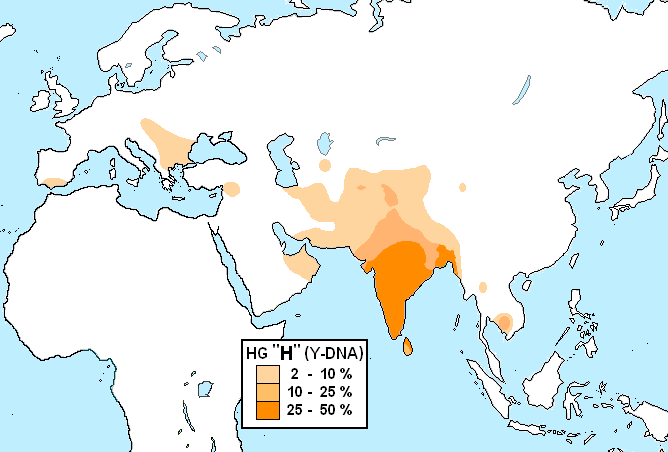
Romani Origins: India is the original homeland of the Romani people or better known as Gypsies. The Romani people are historically, genetically and linguistically connected to India. According to historical data the Roma’s first appearance in Europe was in the 14th century. The term “Gypsy” comes from the misbelief Europeans had that the Roma were Egyptian. There were other misbeliefs the Europeans held of the Roma that lead to many persecutions the Romani populations faced over the hundreds of years since their arrival in Europe. Below is the latest genetic and most accurate map of the Romani genetics origins provided to us by worlds leading geneticist Dr. Kumaraswamy Thangaraj. Northwest India being the cultural, linguistic homeland of the Romani while South Indian Dravidian genetics being the ancient origin in the Romani genetic trail.
Kumarasamy Thangaraj Centre for Cellular and Molecular Biology
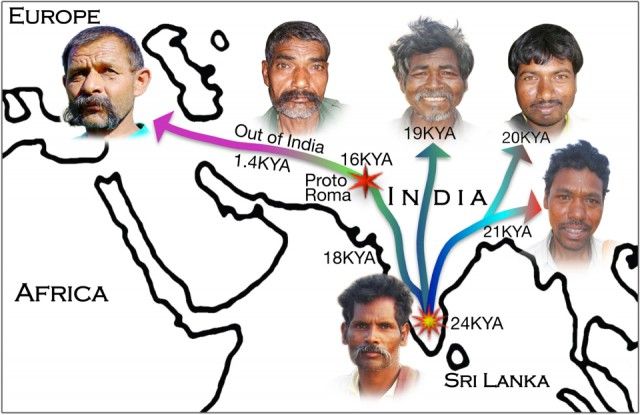
Map below shows Haplogroup H- found in South Asians (predominantly in South Indian Dravidian populations) and Romani people of Europe.
 Oliver Rajamani